
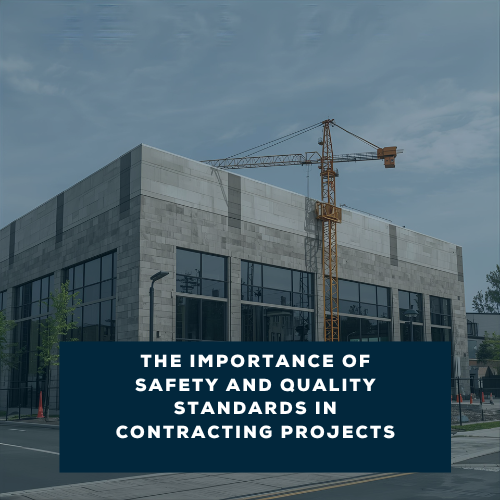
Every successful contracting project has two pillars behind it — safety and quality. When either of these is compromised, the impact isn’t just financial. Lives may be jeopardized, schedules may fail, and companies may lose reputation. That is why responsible contractors treat safety and quality not as legal obligations, but as non-negotiable values that guide every stage of a project.
As one of the most dependable contracting companies in Jubail, EGT has seen firsthand how strong standards build trust, reduce risks, and deliver results that last. Safety protects people. Quality protects the future. When both move together, a project becomes sustainable.
Safety Standards: Protecting People and the Work Environment
Construction and contracting places inherently are associated with heavy machinery, big structural works, electrical work, work at heights, and human coordination. A single lapse can cause grave effects. That is why good safety regulations are not optional ones, they are the cornerstone of a responsible project implementation.
A safety-driven project ensures:
- Workers return home safe every day
- Equipment and resources are protected from accidents
- Productivity stays steady without interruptions
- Clients gain confidence in the contractor they work with
Contracting projects that prioritise safety always perform better because fewer disruptions mean stronger momentum and faster delivery.
Quality Standards: Building Strength That Lasts
Quality isn’t something you check at the end of a project. It begins from the first planning document and continues until final handover. Sustainable construction is about durability, precision, and smart use of resources — not shortcuts.
When quality standards are respected :
- Structural durability improves dramatically
- Maintenance and repair costs stay low for years
- Client satisfaction increases, leading to long-term partnerships
- Every stakeholder benefits from a reliable final outcome
A project that looks good from the outside but fails inside is not a completed project. True quality stands the test of time.
Why Safety and Quality Must Work Together
Many delays and cost overruns in the contracting industry are not caused by poor labor or lack of materials — they happen because safety and quality were treated as separate priorities instead of one shared foundation. The best contractors build a culture where workers understand why certain procedures exist, not just what to follow.
Projects that combine both pillars achieve :
- Fewer workplace incidents
- Better workflow coordination
- Higher client retention
- Strong reputation in the market
Safety protects the workforce today. Quality protects the structure tomorrow. Together, they protect the business long term.
EGT’s Approach to Safety and Quality
EGT is also proactive and prevention-oriented instead of reactive to emergent problems. Each of the phases in a project such as, planning, sourcing, execution, inspection and handover, will pass through a well-defined model that aims at ensuring that people remain safe and that the final product will surpass expectations.
EGT’s safety and quality approach includes:
- Task-specific risk assessments before beginning any activity
- Periodic onsite safety training and toolbox sessions
- Usage of certified equipment and approved materials
- Strict compliance with project-specific and national safety rules
- Real-time inspection and reporting system
- Documentation of lessons learned for continuous improvement
This is why EGT has been consistently trusted in projects where precision, reliability, and safety cannot be compromised.
Common Misconceptions That Hurt Contracting Projects
Many incidents in the industry happen because safety is viewed as extra time and quality as extra cost. In reality, investment in both saves significantly more time and money.
Misconceptions that delay progress :
- “Safety rules slow down the work” — accidents slow it even more
- “Low-cost materials mean higher profit” — they cause higher repair expenses
- “Training is unnecessary” — untrained workers create project delays
Smart contractors look at value, not shortcuts.
Clients Value Responsibility More Than Speed
Delivering fast matters — but delivering safely and correctly matters more. Clients today prefer contractors who commit to ethical execution. No client wants a project that invites future risks, legal issues, or structural uncertainty.
Strong safety and quality standards translate to :
- Smoother regulatory approvals
- Better insurance outcomes
- Stronger credibility and repeat projects
This is why responsible contracting companies in Dammam and across the Eastern Province are shifting their focus toward long-term performance, not rapid completion.
Each building, plant, warehouse or infrastructure project has a story of how it was constructed. In case the process was hurried, unsafe and not supervised properly, the structure will show that over time. However, when safety and quality are used as values, the outcome is self-explanatory a reliable project that works smoothly.
EGT continues to reinforce this belief by creating job sites where people feel protected, and clients feel reassured that their investment is built to last.
FAQs
1. Why are safety standards essential in contracting and construction projects?
They safeguard workers, eliminate operational delays, reduce legal and financial liability, and facilitate the smooth flow of projects without accidents and delays that delay the work schedule.
2. What are the most common safety regulations contractors must follow?
The common regulations consist of the use of PPEs, hazard analysis, equipment examination, height safety, electrical safety process, emergency response planning, and close supervision to make sure that workers adopt accepted safe-work practices.
3. How do quality standards impact the long-term success of a project?
They make it more durable, eliminate expensive repairs, reduce structural failures, enhance client satisfaction, and make the completed project reliable in all aspects, including longevity.
4. What should be done in case a contractor does not observe necessary safety requirements?
It may cause accidents, injuries, legal fines, closure of work, reputation loss, and costly delays, which are detrimental to the contractor and client.
5. Does EGT periodically review its safety and quality policies?
Yes. EGT performs regular audits, updates safety measures, analyzes past issues, and continuously refines its systems to align with project needs and international standards.
6. What quality assurance processes does EGT Group follow?
EGT uses certified materials, trained professionals, documented inspection systems, measurable performance criteria and final-stage verification to ensure every part of the project meets strict quality expectations.